EXOTIC BIRDS:
HYACINTH MACAW:

The hyacinth macaw (Anodorhynchus hyacinthinus), or hyacinthine macaw, is a parrot native to central and eastern South America. With a length (from the top of its head to the tip of its long pointed tail) of about one meter it is longer than any other species of parrot. It is the largest macaw and the largest flying parrot species; the flightless kakapo of New Zealand outweighs it at up to 3.5 kg. While generally easily recognized, it could be confused with the smaller Lear's macaw. Habitat loss and the trapping of wild birds for the pet trade have taken a heavy toll on their population in the wild, so the species is classified as Vulnerable on the International Union for Conservation of Nature's Red List,[1] and it is protected by its listing on Appendix I of the Convention on International Trade in Endangered Species of Wild Fauna and Flora (CITES).
VICTORIA CROWNED PIGEON:
The Victoria crowned pigeon (Goura victoria) is a large, bluish-grey pigeon with elegant blue lace-like crests, maroon breast and red irises. It is part of a genus (Goura) of four unique, very large, ground-dwelling pigeons native to the New Guinea region. The bird may be easily recognized by the unique white tips on its crests and by its deep 'whooping' sounds made while calling. Its name commemorates the British monarch Queen Victoria.The Victoria crowned-pigeon is one of three unique pigeons native to New Guinea. It is named for the elegant, blue, lace-like crest on its head. They forage on the forest floor for fallen fruit (particularly figs), berries, seeds, and insects.
GREY CROWNED CRANE:
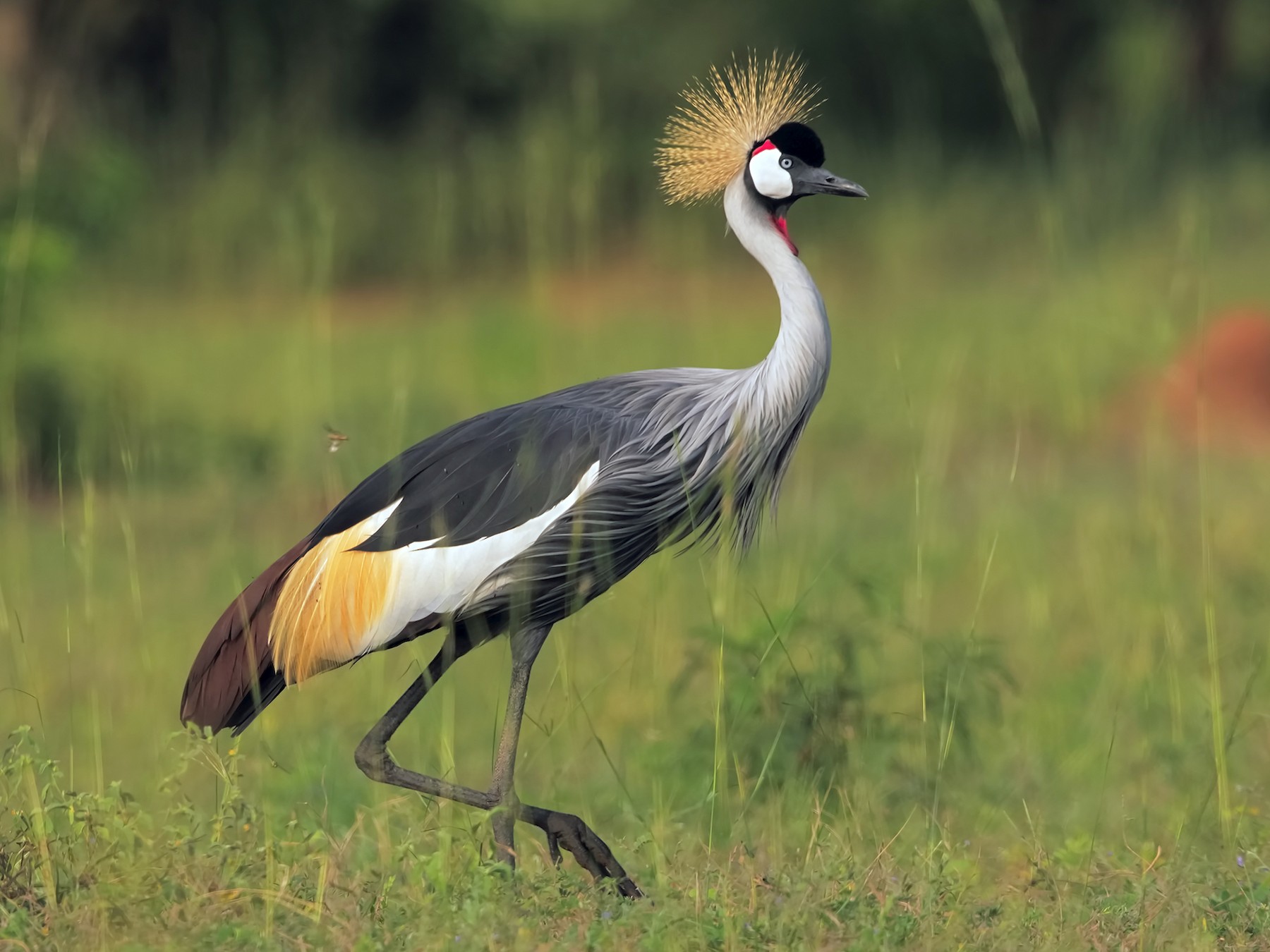
The grey crowned crane (Balearica regulorum), also known as the African crowned crane, golden crested crane, golden crowned crane, East African crane, East African crowned crane, African crane, Eastern crowned crane, Kavirondo crane, South African crane and crested crane, is a bird in the crane family, Gruidae. It is found in eastern and southern Africa, and is the national bird of Uganda.The grey crowned crane is listed as endangered due to threats such as habitat loss and the illegal removal of the birds and their eggs from the wild. These actions have driven very rapid declines during the past 3 generations (45 years).Found in the grassland and wetland areas of the eastern and southern regions of Africa and standing at over a metre tall, there's no mistaking these giants of the bird world.
GOLDEN CONURE:
The golden parakeet or golden conure, (Guaruba guarouba), is a medium-sized golden-yellow Neotropical parrot native to the Amazon Basin of interior northern Brazil. It is the only species placed in the genus Guaruba.Golden conures are active pets that love to climb, chew, and play. Owners must be diligent to supervise these birds when out of the cage to avoid accidents due to their overwhelming curiosity about the world around them.The golden conure truly lives up to its name. It is a beautiful, yellow bird that is also quite rare. They are well-known for being excellent pets, as they are easily tamable and quite affectionate. Many owners describe them as intelligent and entertaining to watch.
AUSTRALIAN KING PARROT:
The Australian king parrot (Alisterus scapularis) is a species of parrot endemic to eastern Australia ranging from Cooktown in Queensland to Port Campbell in Victoria. Found in humid and heavily forested upland regions of the eastern portion of the continent, including eucalyptus wooded areas in and directly adjacent to subtropical and temperate rainforest. They feed on fruits and seeds gathered from trees or on the ground.The Australian king parrot was first described by the German naturalist Martin Lichtenstein in 1818 as Psittacus scapularis. The species belongs to the genus Alisterus, whose three members are also known as king parrots. The species are sometimes allied to the genus Aprosmictus.
COCKATOOS:
Cockatoos are recognisable by the prominent crests and curved bills. Their plumage is generally less colourful than that of other parrots, being mainly white, grey or black and often with coloured features in the crest, cheeks or tail. On average they are larger than other parrots; however, the cockatiel, the smallest cockatoo species, is a small bird. The phylogenetic position of the cockatiel remains unresolved, other than that it is one of the earliest offshoots of the cockatoo lineage. The remaining species are in two main clades. The five large black-coloured cockatoos of the genus Calyptorhynchus form one branch. The second and larger branch is formed by the genus Cacatua, comprising 11 species of white-plumaged cockatoos and four monotypic genera that branched off earlier; namely the pink and white Major Mitchell's cockatoo, the pink and grey galah, the mainly grey gang-gang cockatoo and the large black-plumaged palm cockatoo.
GREEN ARACARI:
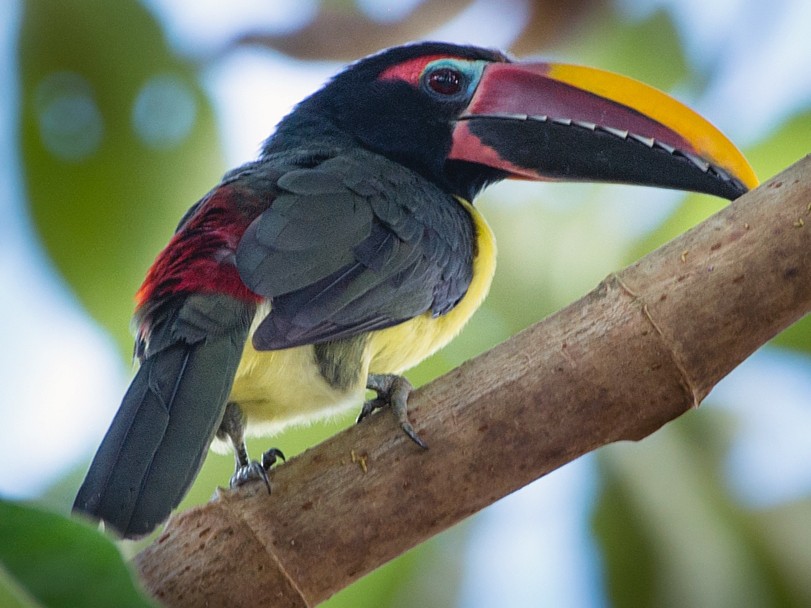
Adult aracaris measure 12 to 16 inches in length, and weigh between 3.9 and 5.7 ounces. Their lifespan in the wild is typically four to six years, but in human care a bird once lived to be 18 years old.The green araçari (Pteroglossus viridis), is a toucan, a near-passerine bird. It is found in the lowland forests of northeastern South America (the Guiana Shield), in the northeast Amazon Basin, the Guianas and the eastern Orinoco River drainage of Venezuela. At 30–40 cm. (12–16 in) long and weighing 110–160 grams (3.9–5.7 oz.), it is the smallest aracari in its range, and among the smallest members of the toucan family.
ARCHANGEL PIGEON:
The Archangel is a breed of fancy pigeon, notable for the metallic sheen of its feathers. Archangels, along with other varieties of domesticated pigeons, are all descendants from the rock pigeon (Columba livia). It is kept as an ornamental or fancy breed, valued for its unusual appearance. Archangels are small, weighing about 12 oz. They have unfeathered legs and dark orange eyes. They may or may not be crested. The body of the bird is bronze or gold with wings that are either black, white, or blue.This breed is also known as the Gimpel, which is German for Eurasian bullfinch. The United States is the only country in which all color forms are referred to as "Archangels", in Great Britain only the black and copper colored birds are called Archangels, this is because the black and copper color type was created in Great Britain.
MASKED TROGON:
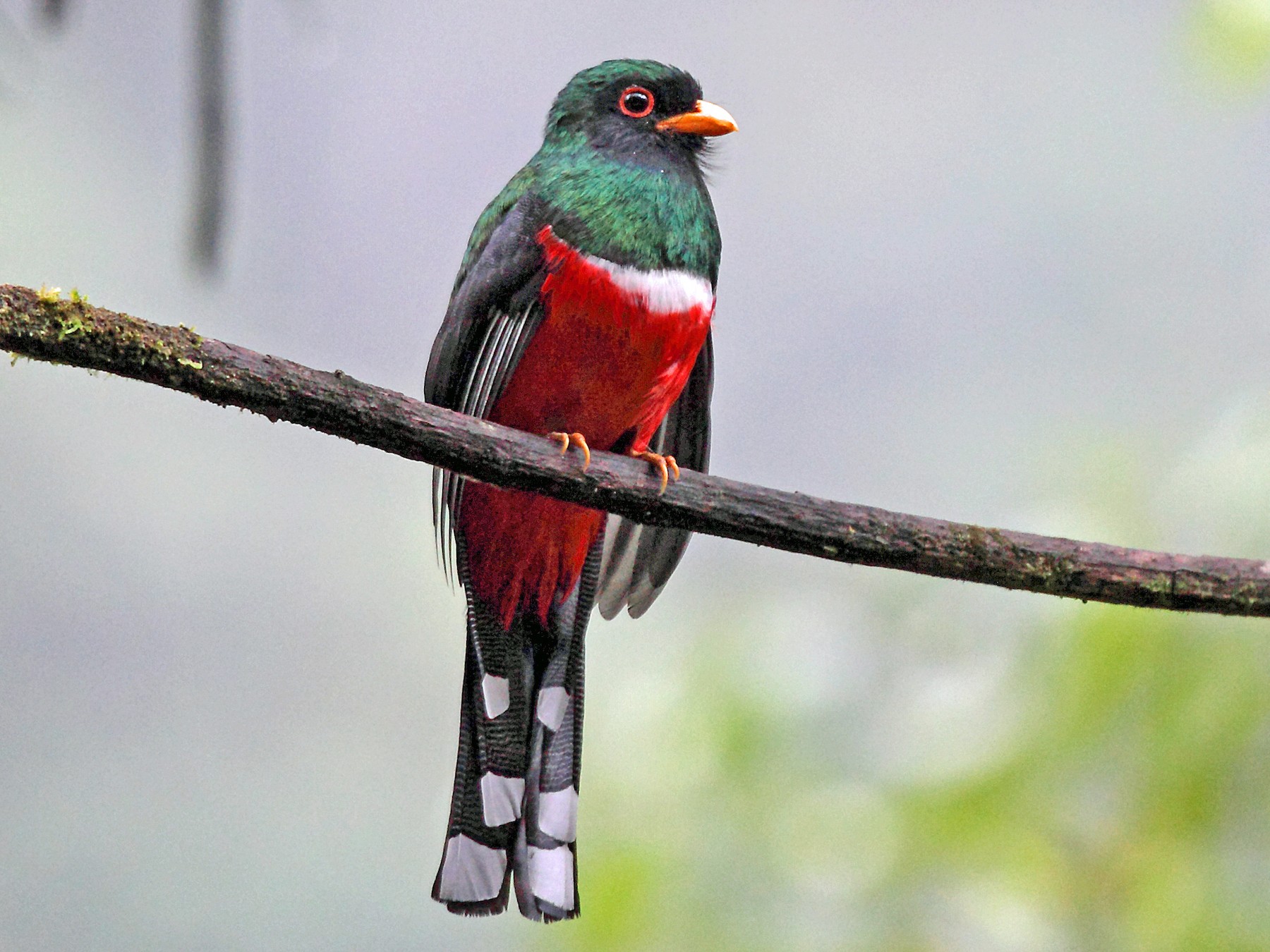
Average red-bellied trogon of subtropical forests. Male is iridescent green on breast, head, and back; female is brown. Namesake dark mask is usually obvious, especially on females. Nearly identical to Collared Trogon but very little overlap; Masked is almost always found at higher elevations. Where both are possible, look especially at tail pattern on males: large white tips on underside of tail feathers, otherwise dark with very fine white barring. On females, look for evenly barred undertail with large white tips combined with contrasting black face. Usually found singly or in pairs, perched quietly from the understory to the subcanopy. Listen for slow series of 3–6 descending whistles.
TRICOLOURED MUNIA:
Small, finchlike bird of weedy and grassy areas in tropical lowlands. Often in small flocks, which associate readily with seedeaters and grassquits. Adult is handsome and striking with rusty upperparts. Black head and underparts are cut by a broad white swath from flanks across the lower breast. Note stout gray bill. Juvenile notably plain, buffy brown overall with stout bluish-gray bill. Note the pointed tail, unlike seedeaters and grassquits. Native to Asia and spreading in New World as an escaped cage bird.
SWALLOW-TAILED COTINGA:
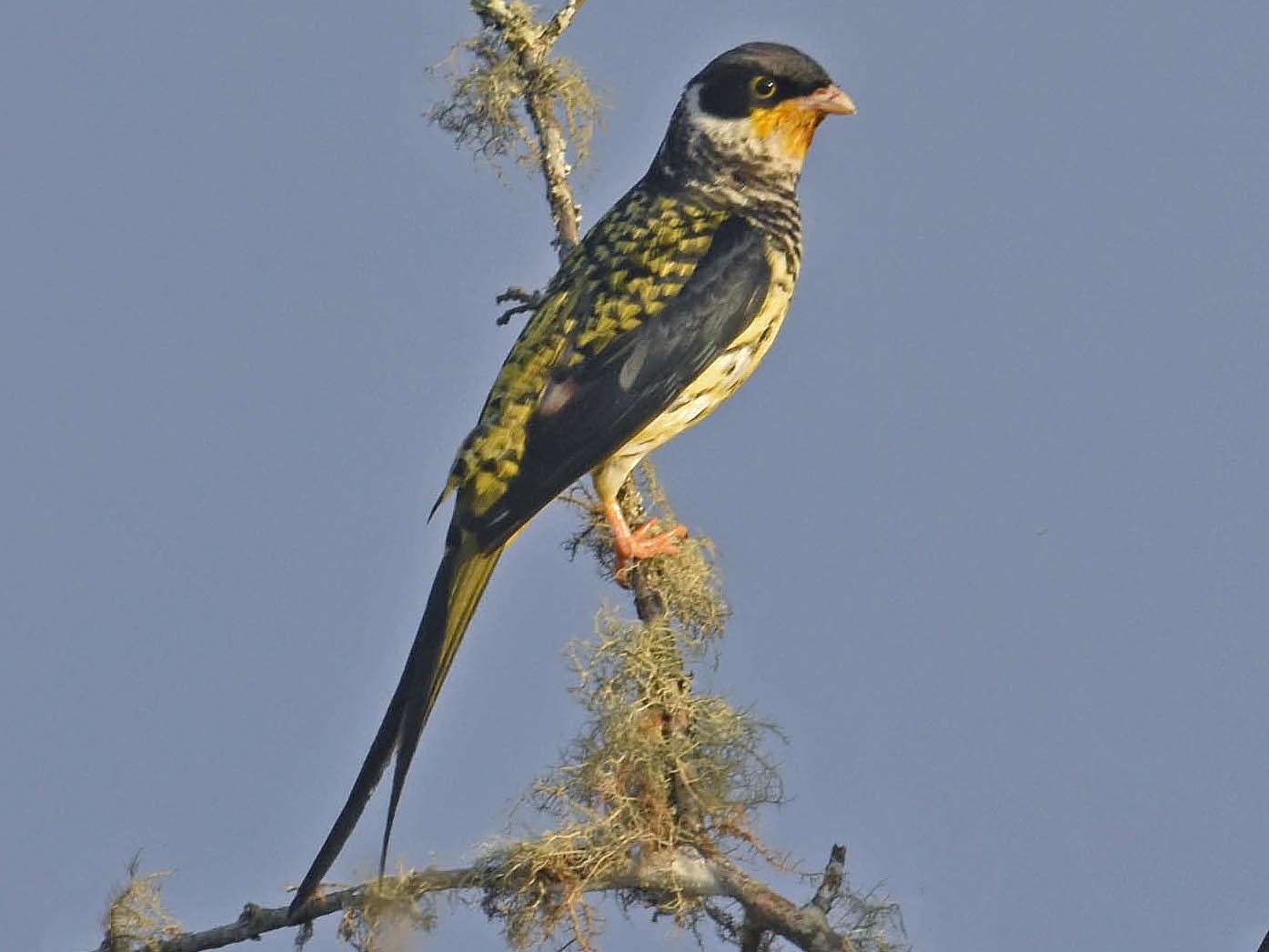
Visually striking cotinga with an intricate plumage pattern and a long, deeply-forked tail, which is yellow at the base and darker towards the tip. Note the black cap contrasting with a pale bill, yellow chin, and a pied scaly shawl. The back is spotted olive and black and the underparts are yellow and white with odd spots. Usually seen perched on the top of trees at forest edges and in woodlands and open areas with scattered trees. Usually silent.
THE RESPLENDENT QUETZAL(PHAROMACHRUS MOCINNO)
The resplendent quetzal (Pharomachrus mocinno) is a small bird found in southern Mexico and Central America, with two recognized subspecies, P. m. mocinno and P. m. costaricensis. These animals live in tropical forests, particularly montane cloud forests and they are part of the family Trogonidae. Like other quetzals, the resplendent is omnivorous; its diet mainly consists of fruits of plants in the laurel family, Lauraceae, but it occasionally also preys on insects, lizards, frogs and snails.
HERE ARE SOME EXOTIC BIRDS


Birds are a group of warm-blooded vertebrates constituting the class Aves (/'e?vi?z/), characterised by feathers, toothless beaked jaws, the laying of hard-shelled eggs, a high metabolic rate, a four-chambered heart, and a strong yet lightweight skeleton.
Birds live worldwide and range in size from the 5.5 cm (2.2 in) bee hummingbird to the 2.8 m (9 ft 2 in) ostrich.
There are about ten thousand living species, more than half of which are passerine, or "perching" birds. Birds have wings whose development varies according to species; the only known groups without wings are the extinct moa and elephant birds. Wings, which are modified forelimbs, gave birds the ability to fly, although further evolution has led to the loss of flight in some birds, including ratites, penguins, and diverse endemic island species. The digestive and respiratory systems of birds are also uniquely adapted for flight. Some bird species of aquatic environments, particularly seabirds and some waterbirds, have further evolved for swimming.
Birds are feathered theropod dinosaurs and constitute the only known living dinosaurs. Likewise, birds are considered reptiles in the modern cladistic sense of the term, and their closest living relatives are the crocodilians. Birds are descendants of the primitive avialans (whose members include Archaeopteryx) which first appeared about 160 million years ago (mya) in China.
According to DNA evidence, modern birds (Neornithes) evolved in the Middle to Late Cretaceous, and diversified dramatically around the time of the Cretaceous–Paleogene extinction event 66 mya, which killed off the pterosaurs and all non-avian dinosaurs.
Many social species pass on knowledge across generations, which is considered a form of culture.
Birds are social, communicating with visual signals, calls, and songs, and participating in such behaviours as cooperative breeding and hunting, flocking, and mobbing of predators.
The vast majority of bird species are socially (but not necessarily sexually) monogamous, usually for one breeding season at a time, sometimes for years, and rarely for life.
Other species have breeding systems that are polygynous (one male with many females) or, rarely, polyandrous (one female with many males). Birds produce offspring by laying eggs which are fertilised through sexual reproduction. They are usually laid in a nest and incubated by the parents. Most birds have an extended period of parental care after hatching.
Many species of birds are economically important as food for human consumption and raw material in manufacturing, with domesticated and undomesticated birds being important sources of eggs, meat, and feathers.
Songbirds, parrots, and other species are popular as pets.
Guano (bird excrement) is harvested for use as a fertiliser. Birds figure throughout human culture. About 120 to 130 species have become extinct due to human activity since the 17th century, and hundreds more before then. Human activity threatens about 1,200 bird species with extinction, though efforts are underway to protect them. Recreational birdwatching is an important part of the ecotourism industry.