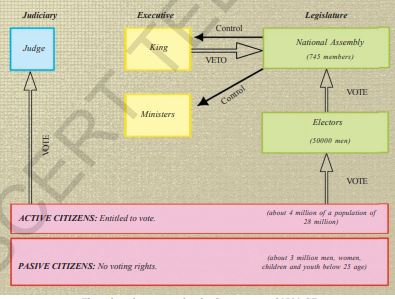
The National Assembly completed the draft of the Constitution in 1791 CE. Its
main object was to reduce the powers of the monarch. Now these powers were not
in the hands of one person. They were now separated and given to different
institutions - the legislature, executive and judiciary. This made France a
constitutional monarchy.
The Constitution of 1791 CE gave the National Assembly the power to make laws.
But all the citizens did not have the right to vote. Only the active citizens had the
right to vote. Active citizens were men above 25 years of age, who paid taxes equal
to at least 3 days of a labourer’s wage. The active citizens voted for a group of
electors, who in turn chose the Assembly.
To become an elector and a member of the Assembly, a man had to belong to
the category of highest taxpayers. The Constitution began with a Declaration of the
Rights of Man and Citizen. Rights such as the right to life, freedom of speech,
freedom of opinion, equality before law, were considered as ‘natural and inalienable’
rights. This means that the rights belonged to each human being by birth and could
not be taken away. It was the duty of the government to protect these 17 citizen’s
natural rights.