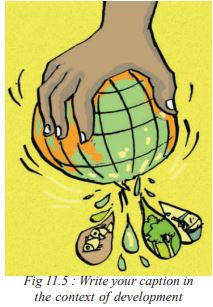
For long, policymakers have ignored the environmental issues. The argument
has been that since developing countries like India are poor, developing economies
need to grow. Development has to be achieved at any cost. It is argued that growth in
GDP and modern industrial development are necessary, for raising the living standards
of people and reducing poverty. Since modern industrial and agricultural development
are intensive in use of natural resources including energy, the depletion of these
resources and pollution of the environment is to be expected. It is a sacrifice that has
to be borne for higher growth. Once the high economic growth and prosperity is achieved,
pollution and environmental degradation can be handled. One can spend money and clean up
the air and rivers, drink bottled water and build cars that are fuel efficient. After all,
this is the route that the developed countries have taken
This logic is wrong for various reasons. By now, you would have realised that
the environment is already in a disastrous state on various fronts. India is a big
country with a huge population. If we continue to grow and consume energy and
other resources and also pollute the environment as the developed countries have
done, it would be catastrophic for earth. The damage to the environment will simply
not be reversible. Hence, the idea that environmental damage is self-correcting is
wrong. Besides, we certainly do not want the environment to be destroyed before
it is reclaimed. Future generations, even if they restore the damage, would have to
spend crores of rupees to clean up the mess created today. For example, to clean
up our rivers and drains, we need to spend money today besides ensuring that they
are not polluted again and any further. Do you think we should follow a path that
destroys the natural resources and leaves them worse for future generations? Can we not
perceive the contradiction: we first encourage and celebrate a lifestyle that invites the
disease and then spend thousands of rupees on its cure?
We are already experiencing the negative consequences of rapid economic growth on
several fronts – the problem of groundwater and pesticides being two stark examples. We
have several thousands of communities living off the environment. To destroy the
environment means to destroy these communities. It is unjust to ask the poor people to
bear the cost of development.
Of course, this doesn’t mean that we don’t progress. But we should be able to integrate
environmental concerns with the idea of progress, along with issues of equity and justice.
We have to