Land reform was launched in 1950-51 after two years of relatively peaceful
attempts to understand rural situation and forming peasant associations etc.
The major steps were: a class identification of all the people living in the villages, followed by
the confiscation and redistribution of landlord land and other productive property. Work teams that
were dispatched by county-level land reform committees played A leading role in the process. One of
their main functions was to set up peasant associations and select activists from them for local
leadership positions. This new leadership was mostly from the poor peasants and middle peasants. In
many areas, middle peasants were able to dominate because they were more skilled. In addition, the
work teams mobilised the villages against the landlords through mass meetings and trials.
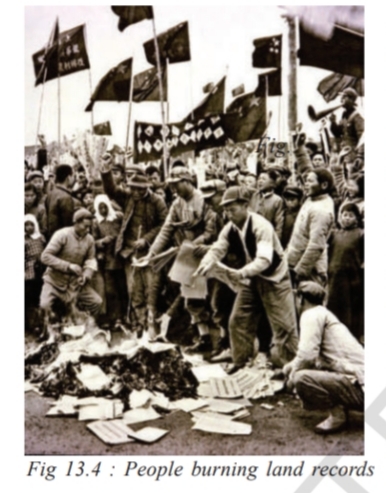
The landlords were made to face public humiliation. A large number of members
of this class were also executed in these trials, perhaps 10 to 20 lakh individuals.
As an economic reform program, about 43 percent of China’s cultivated land
was successfully redistributed to about 60 percent of the rural population.
Even though the holdings of poor peasants substantially increased, the middle
peasants actually benefited the most from land reform because of their stronger
initial position.
The old elite had to lose its economic assets and power while a new elite class
of village people emerged from poor and middle classes. These people had been
brought into political work by the CCP. Along with the land reforms, another big
effort was the setting up of adult peasant schools to spread literacy and political
education. Along with this, primary schools were set up for both young children and
adults in all the villages.
|
Most scholars agree that the success of the land reforms and universalisation of education in the
initial years of the revolution formed a solid basis for future development of China. The CCP rule
gradually established a single party rule in which the supreme leaders or "Chairman" was all
powerful. All opposition activities were disallowed