such as the reservation of seats in legislatures. The Constitution also made it possible for the government to reserve public sector jobs for these groups.
The Constitution also has in it the “Directive Principles of State Policy” which sets out the main social systems before the government. One important aspect of the social engineering is the problem of the right of minorities. The sad experience of suppression of Jewish minority in Nazi Germany weighed in the minds of the Constitution makers. They decided to give special protection to the minority community so that they don’t feel marginalised by the majority. One such right is the right of religious minorities to run their own educational institutions. Such institutions may even receive government funds.
The Constitution Today
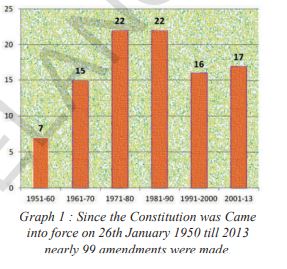
The Constitutional makers were aware that laws will have to be amended from time to time. Thus, it laid down the provisions for amending the laws and the articles in the Constitution as well. Often laws can be made with approval of more than half the members in legislative houses. However, amending the articles in the Constitution can be initiated only by the Parliament. It also needs the approval of 2/3rd members in both the houses of parliament - Rajya Sabha and Lok Sabha. And some articles may be amended only with acceptance (or ratification) from the state legislature as well. It is further necessary that the President of the country also approves the new amendment bill like other laws.
Some major changes in the Constitution were made during 1970s. The first among them is inclusion of two words into the Preamble of the Constitution “Secular” and “Socialist”. Many words in the preamble like “Equality”, “Liberty”, “Justice” etc emphasised the values of secularism and socialism and hence, these words were added. The second major event in the life of Indian Constitution has been a Supreme Court judgement popularly known as Keshavanada Bharati case. It was argued here that certain provisions in the Indian Constitution cannot be changed under any circumstances. One among them is the Fundamental Right. In the judgement on Keshavanada Bharati case, Supreme Court argued that there are certain basic principles upon which the nation continues to exist. While there have been different