The USSR also tried to expand its sphere of influence. To begin with, in 1950s,
it had to face the resistance of countries like Germany, Hungary and
Czechoslovakia. It sent its armies to dismiss unfriendly governments and install
friendly governments in those countries. After 1960s, China decided to disassociate
itself from the USSR and the latter tried unsuccessfully to pressurise China. In
1971, USSR invaded Afghanistan to install a friendly government there. The US
in turn provided armed support to Afghan rebels who were also religious
from Afghanistan in 1985, the country fell to religious extremists led by the Taliban
extremists. A prolonged civil war ensued and as the USSR decided to withdrawv
which has now turned against the USA. In all this chaos, we can see that the threat
of warfare and destruction was faced by the third world which was trying to emerge
out of colonial control and the wars were not fought so much by the Soviet or US
troops but by the people of the third world.
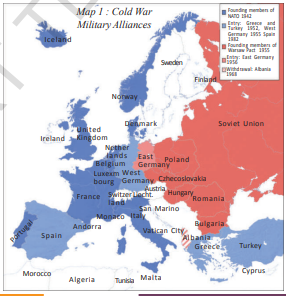
Military Alliances
Both USA and USSR were in possession of nuclear weapons but knew very
well that neither would be a winner in a nuclear war. Yet, they formed military and
strategic alliances - the west formalised its alliances in an organisation known as
North Atlantic Treaty Organisation (NATO) in 1949. To counter this, Communist
nations made similar alliances and signed the Warsaw Pact. In addition to this,
U.S. established regional military and strategic alliances like South East Asian
Treaty Organisation
(SEATO) and Centralv
Treaty Organisation
(CENTO).
Even though they
strengthened themselves
by creating military
blocks, they knew that
fighting wars would lead
to a massive destruction
of human life, threatening
the whole civilisations.
Hence, they maintained a
constrained relationship
acting as a deterrent to
each other.
The alliances helped the
super powers which wanted
to expand their inf