As time passed, USSR and USA came under tremendous public pressure to roll back the arms race and destroy their nuclear arsenal. You will read more about this later on in this book. This forced them to hold talks to mutually reduce the stockpile and weapons race and eventually to ban nuclear tests between 1985 to 1991. This was largely made possible by the coming to power of Mikhail Gorbachev in the USSR. He tried to transform the politics of USSR by making it more open
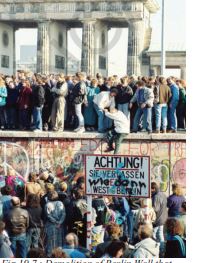
This was largely made possible by the coming to power of Mikhail Gorbachev in the USSR. He tried to transform the politics of USSR by making it more open and bringing about radical changes. He was a liberal who introduced certain reforms for the revival of their economy and promoted healthy relations with the West. The reforms introduced by the open regime are often described as ‘Glasnost’ and ‘Perestroika’. Around the same time, the countries of Eastern Europe faced serious economic crises and the USSR was not in a position to help them. As a result, popular movements demanding freedom, democracy and economic reforms swept across Eastern Europe. Soon, the governments were unable to manage the country and collapsed. This is best symbolised by the breaking down of the infamous Berlin Wall that separated Eastern and Western Germany and symbolized the unpopular control of the USSR over Germany. In the USSR itself, Communist hardliners

encouraged a coup in 1991 to remove Gorbachev from power. This backfired and Boris Yelstin resisted the coup on behalf of the Russian parliament. He eventually won the Presidential elections and announced the disbanding of the USSR in 1991. The components of the former USSR became independent countries and many of them formed an alliance with Russia later on. With the collapse of the USSR, a new era began in world politics: the era of unipolar world and the era of Globalisation. You studied about this in a separate chapter in this book.