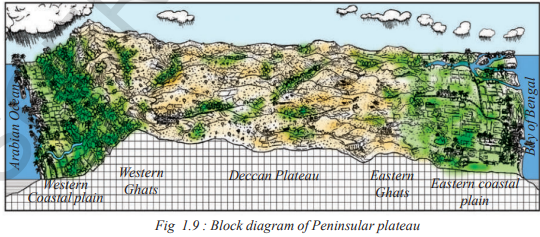
The Indian plateau is also known as the peninsular plateau as it is surrounded by the sea on three sides. It is mainly composed of the old crystalline, hard igneous and metamorphic rock. Large amounts of metallic and non metallic mineral resources are found in the Indian plateau. It has broad and shallow valleys with rounded hills. The topography of the plateau is slightly tilted towards east and the Western and Eastern Ghats form the western and eastern edges respectively. The southernmost tip of the plateau is Kanyakumari.
The peninsular plateau consists of two broad divisions, namely, the central high lands (Malwa plateau) and the Deccan Plateau. On the physical map of India, adjunct to and south of the Gangetic plains and north of the river Narmada, you can identify central highlands. Prominent plateaus here are Malwa plateau on the western side and towards the east, there is the Chotanagapur plateau. In comparison to the Gangetic plains, the plateau region is dry. The rivers are not perennial. The irrigation for the second crop depends on deep tube wells and tanks. Identify rivers that flow on the Northern side of central high lands. Chotanagapur plateau is rich in mineral resources.