deteriorated. A standard of 2100 Kilocalories per day in urban areas and 2400
Kilocalories in rural areas is the recommended food intake per day
The national average calorie levels in both rural and urban areas are below the
needed calorie requirements. Also, the consumption of calories has gone down between
1983 and 2004. This is shocking since as we have seen that our economy is growing at
a rapid rate. Production of goods and services has increased multiple times
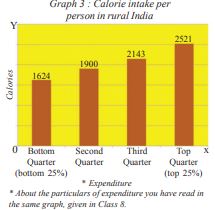
This is not all. Averages hide the disparities in distribution. Whereas the very
well-off consume food that goes beyond the recommended calorie requirements, for a
large proportion of the population, the food intake is inadequate to provide the
calories required. 80 percent of people in rural areas in India consume food that is
below the calorie standard. In the Graph 3, you can see the lowest calorie intake is
for the people who are the poorest in the rural areas. And it is waybelow the
recommended standard of 2400! Whereas these are the people who are involved in the
most difficult and heavy manual labour
The major reason for low calorie intake is the lack of purchasing power of the
people. People don’t have adequate incomes to buy food. There are various reasons
for this as you have read in the discussions on poverty, unemployment, public
facilities, etc. Can you recall some of these before you proceed?
Ration shops are important means for people to access foodgrains in India. One
survey was conducted in 2009-10 to know whether families in different states procure
foodgrains from public distribution system fair price shops and how much are they
part of the total foodgrain consumption. Look at the Graph 4. This shows people’s
dependency on PDS for the purchase of their staple food grains different states of
India
|
Studies indicate that Southern statesof India have a good record in public
distribution system. Notably, these are the states that have followed a universal
PDS system which means that low cost foodgrains would be available to all. This is
in contrast to other states where poor families have been identified and foodgrains
are sold to at different prices to poor and non-poor. Even among the poor, the very
poor have different entitlements, or