guarantees for access. For example, the Antyodaya cardholders are entitled to get
35 kgs of foodgrains (rice and wheat) per month per family.
Fill in the blanks
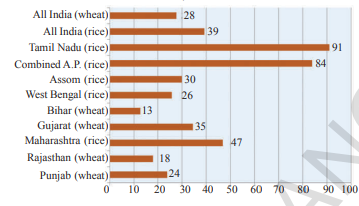
For all India, ____ percent of peoples’ total consumption of rice and ____ percent of peoples’ total consumption of wheat are purchased from the ration shops. This shows that people have to buy most of their foodgrain requirements from ____. However, there are several well-performing states like____and ____. And some states like ____, ____ ,____ where PDS hardly seems to be fulfilling peoples’ needs for foodgrains.
PDS and Buffer Stock
The stock of foodgrains mainly wheat and rice procured and maintained by the
government through Food Corporation of India (FCI) is called buffer stock. The FCI
purchases wheat and rice from the farmers in states where there is surplus production. The farmers are paid a pre-announced price for their crops. This price is called Minimum Support Price (MSP). The MSP is declared by a government agency every year.
The state and Central Governments procure nearly one-third of foodgrains from
farmers. These foodgrains are distributed to people through various mechanisms. In
recent times, the government agencies are procuring more foodgrains than what is
required to meet the public distribution system. If government stocks keep increasing
year after year, less is available (see year 2011 in Table on foodgrain availability). The government has been often criticised that it does not properly distribute these foodgrains to the needy people. Sometimes, governments also exports these foodgrains to other countries. Do you think it is good idea to export foodgrains and earn a small income when a large section of people within the country are not able to access foodgrains?
The Indian government came out with a new law in 2013 called the National
Food Security Act to legalise peoples’ Right to Food. It applies to approximately 2/
3rd of the population of India. As per this law, every person of low income families
is entitled to 5 kilograms of foodgrains per month at subsidised rates. Among poor