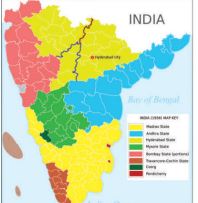
of very large states like Central Provinces and Berar. A large part of the country was under princely states. In each of these, people speaking many different languages were living together. For example, Madras Presidency had in it people speaking Tamil, Malayalam, Kannada, Telugu, Gondi and Oriya languages. All the people speaking a language and living in contiguous areas demandedto be organised under one state. These included thecampaign for Samyukta Karnataka (uniting Kannada speakers spread across Madras, Mysore, Bombay and Hyderabad), Samyukta Maharashtra, the Mahagujarat movement, the merger of Travancore and Cochin princely states and the state of Punjab for Sikhs. Would agreeing to these demands help to build the unity of the country or would it lead to the breaking of the country along linguistic lines was the main concern?
The partition of the country on the basis of religion had created doubts and fears about the security and stability of India in the minds of the leadership. There was a fear that language reorganisation would leadto break down of the country. Hence, even though the Congress itself was organisedon the linguistic lines and had promised to restructure the country on those lines, itdeveloped cold feet when independence came.
The most vigorous of all the movements was that of the Telugu speakers which called upon the Congress to implement the old resolutions in favour of linguistic states. The Andhra Mahasabha had been active even during the British rule and was attempting to bring together the Telugu speaking people in the Madras presidency. This movement continued even after independence. The methods used included petitions, representations, street marches and fasts. Given the Congress opposition to this demand, the party did badly in the Telugu speaking areas in the first elections. Theseats went to parties who supported the linguistic movement.